Pass on Credit Card Fees to Customers: Rules and Options
Learn how to pass on credit card fees to customer legally, including surcharge caps, state rules, disclosures, cash discounts, and payment-processing options.
Published

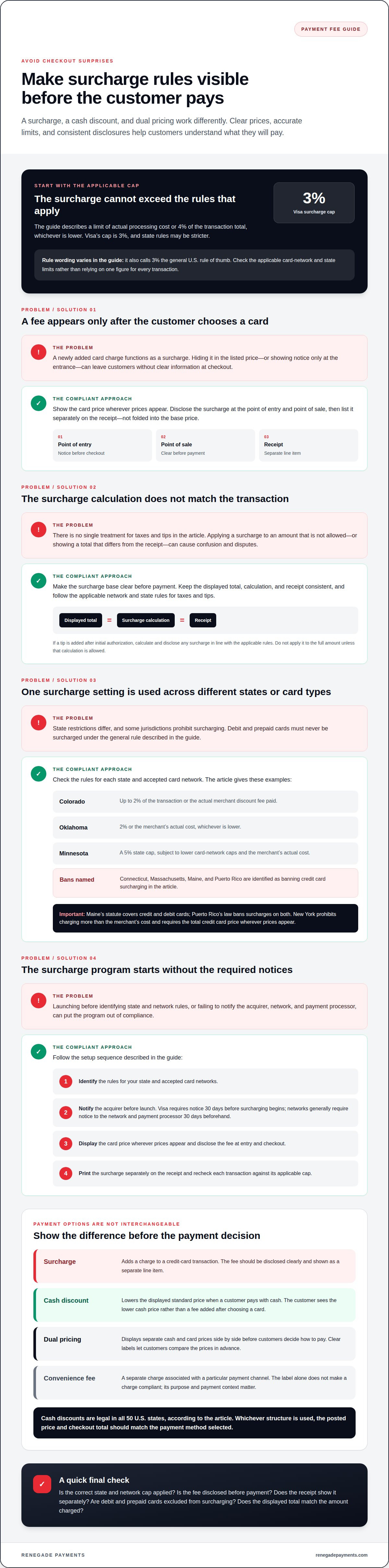
A credit card surcharge isn’t a free-for-all. To pass on credit card fees to a customer legally, the surcharge generally can’t exceed your actual processing cost or 4% of the transaction total, whichever is lower. Visa’s cap is lower, at 3%, and state rules can add further limits.
Processing costs cut into every sale, but adding a fee without understanding the rules can create a bigger problem. A surcharge and a cash discount are not the same, and the distinction matters at checkout.
This guide explains when surcharges are allowed, how cash discounts and dual pricing work, and which disclosures and restrictions apply. It also shows how to compare payment-processing costs without relying on guesswork.
Key Takeaways
- Learn which card-network limits and customer disclosures can shape a surcharge program.
- See how cash discounts differ from surcharges, and why clear advertised pricing matters.
- Understand why state rules can change whether surcharging is allowed and what limits apply.
- Explore how processing costs vary and how dual pricing, interchange-plus, or a savings analysis can help clarify your options.
Table of Contents
Is it Legal to Pass on Credit Card Fees to Customers?
In the United States, surcharges must stay within applicable caps and follow card-network notice and disclosure rules. The exact limit depends on the card network and state law.
Customer-Facing Fee Disclosures
Fee disclosures tell customers about a surcharge before they pay and show it clearly on the transaction record. Card-network rules require notice at the point of entry, point of sale, and on the receipt. Show the surcharge as a separate line item, not folded into the base price. New York General Business Law Section 518 also requires the total credit card price wherever prices appear.
Clear notice lets customers see the card price before committing. For example, a sign at the entrance alone does not replace disclosure at checkout and on the receipt.
Transaction Amounts Subject to Surcharges
The surcharge base is the transaction amount used to calculate the fee. Rules do not establish one universal treatment for taxes and tips, so make the calculation clear before payment and follow the applicable network and state requirements.
Keep the displayed total, surcharge calculation, and receipt consistent. If a tip is added after the initial authorization, calculate and disclose any surcharge in line with the applicable rules. Do not apply it to the full amount unless that calculation is allowed.
Risks of Improper Fee Pass-Throughs
An excessive or poorly disclosed surcharge can trigger card-network consequences or legal action under state law. New York General Business Law Section 518 prohibits a credit card charge above the merchant’s cost. New York fines for surcharge violations can reach $500 per violation.
A surcharge above the permitted cap, missing disclosure, or a charge hidden in the listed price can lead to complaints and enforcement. Customers may also dispute a charge if the checkout total differs from the price they saw.
Setting Up a Compliant Surcharge Program
A small business should first identify the rules for its state and accepted card networks. In the United States, a surcharge cannot exceed the merchant’s actual processing cost or 4% of the transaction total, whichever is lower. Visa’s cap is 3%, even if acceptance costs are higher.
Notify the acquirer before launch: Visa requires notice 30 days before surcharging begins, and card networks generally require notice to the network and payment processor 30 days beforehand. Then post the card price wherever prices appear, disclose at entry and checkout, and print the surcharge separately on receipts. Recheck each transaction against the applicable cap.
Dual pricing and cash discount programs
Cash discounts and dual pricing show payment choices differently from a surcharge. Offering a cash discount is legal in all 50 U.S. states, and the displayed price structure matters.
How Cash Discount Programs Work
A cash discount lowers the displayed standard price when a customer pays with cash. The customer sees a lower cash price, rather than a fee added only after choosing a card.
Set prices and display the cash and card prices clearly before payment. For example, a menu or price list can show both prices side by side. The checkout total should match the price for the payment method the customer chooses. A mismatch between the posted price and register total can confuse customers and undermine trust.
Dual pricing displays separate cash and card prices side by side before customers decide how to pay. Clear labels help customers compare the options and understand the price they will pay, rather than encountering an unexpected fee at checkout.
Comparing Surcharges, Discounts, and Convenience Fees
A surcharge adds a charge to a credit-card transaction; a cash discount lowers the standard price for a cash payment. A convenience fee is a separate charge associated with a particular payment channel. These are different approaches, and using a particular label does not by itself make a charge compliant.
For example, if a customer sees one listed price and a new card charge appears at checkout, that charge functions as a surcharge. If the posted standard price includes processing costs and the customer pays less with cash, that is a cash discount. A convenience fee should be identified by its purpose and payment context, not used as another name for a surcharge.
Businesses considering a dual pricing approach can compare how clearly each payment option appears to customers before they pay. Transparent prices make the difference visible at the decision point.
State-by-state surcharge restrictions
A nationwide rule of thumb is not enough: state laws vary, and some states prohibit surcharges. Check the rules that apply wherever you accept payments before setting up a surcharge program. Debit and prepaid cards must never be surcharged.
The general U.S. surcharge ceiling is 3%, but state laws may impose different caps or stricter restrictions. Examples show why a single checkout setting can create problems across state lines:
- Colorado: A merchant may choose a surcharge up to 2% of the transaction or the actual merchant discount fee paid.
- Oklahoma: The cap is 2% or the merchant’s actual cost, whichever is lower, as of November 1, 2025.
- Minnesota: State law sets a 5% cap, subject to lower card-network caps and the merchant’s actual cost.
- Connecticut, Massachusetts, Maine, and Puerto Rico: These jurisdictions ban credit card surcharging as of October 2026.
California enacted a law banning most credit card surcharges starting in mid-2024. Its 2024 law requires advertised prices to be final prices by banning hidden surcharges. New York General Business Law Section 518 prohibits charging more than the merchant’s cost and requires the total credit card price wherever prices appear. State rules can change what a business may display, even when its card-network settings stay the same.
Debit cards need separate attention. Maine’s surcharge statute covers both credit and debit cards, while government entities are exempt. Puerto Rico’s Law 150 bans surcharges on both credit and debit cards. These rules make it unsafe to assume a credit-card surcharge policy automatically applies to debit transactions. Separate payment types in your checkout system, then apply the relevant state rules to each.
If your business operates across state lines, account for each state’s restrictions before applying a single surcharge setting everywhere. A program that meets one state’s rules may conflict with a prohibition elsewhere. Apply the strictest relevant requirements among state law, network limits, and actual processing costs.
Credit card processing costs
A card-processing bill is not one flat charge. It can combine interchange, network assessments, and processor charges, so a single advertised percentage may not show what drives the total.
Interchange varies by card type and transaction category. These examples show why one advertised rate may not describe every card payment.
The card, transaction category, and payment method all affect processing costs. A rewards card can have a different interchange rate from a basic retail card. Compare statement entries by category, not just the headline rate, to distinguish card mix from processor charges and other costs.
Debit has its own cost structure. The debit interchange cap for large issuers is 21 cents plus 0.05%, with an additional 1 cent fraud adjustment. This differs from credit interchange examples. Don’t use a credit-card cost assumption to estimate every debit transaction.
Processing expense can also affect customer behavior. J.D. Power’s 2025 Merchant Services Satisfaction Study found that 34% of small businesses add a surcharge to credit card payments. The same study found that 41% of credit card users had skipped paying by card because of a surcharge. That tradeoff matters: recovering processing expense can change how customers choose to pay.
Start with your merchant statement. Separate interchange from processor charges, compare card categories, and track payment methods. Then assess whether your pricing approach reflects actual processing costs without assuming every transaction costs the same. For accounting and professional services firms, processing costs are described as typically ranging from 2% to 3% per transaction. A clear breakdown gives you a stronger basis for pricing decisions.
Review your merchant statement to identify the charges shaping your processing costs.
Renegade Payments: Dual Pricing
Renegade Payments helps businesses evaluate payment pricing with Dual Pricing, Free Savings Analysis, and Interchange-Plus. Dual Pricing can help offset processing costs by presenting payment options at checkout. It’s a practical option for businesses weighing transparent payment choices against a surcharge program’s network and state restrictions.
Start with the numbers behind your current setup. Renegade Payments’ Free Savings Analysis reviews merchant statements to uncover hidden processing costs. Interchange-Plus offers a transparent pricing model, helping you understand how processing charges are structured. Clear cost details can help you compare approaches and decide what fits your business.
Use the analysis to understand your processing expenses, then consider whether Dual Pricing fits your checkout and customer experience. Contact Renegade Payments to discuss your payment-processing options.
Make Your Next Pricing Decision With Clarity
Choose an approach that fits how your business prices goods or services, serves customers, and manages processing costs. The goal is not simply to shift an expense. It is to make payment choices clear and costs understandable before checkout.
If you are deciding whether to pass credit-card fees on to customers legally, start with your merchant statements and the experience you want customers to have. Renegade Payments offers Dual Pricing for in-person payments, a Free Savings Analysis, and Interchange-Plus pricing for in-person and online payments. Each can help you understand payment options and processing costs.
Move forward with a pricing model you can explain plainly. Contact Renegade Payments to discuss your payment-processing options and take the next step with confidence.
Frequently Asked Questions
Are businesses legally allowed to pass credit card processing fees to customers in the United States?
Generally, businesses can legally pass credit card fees on to customers through a surcharge, subject to state law and card-network rules. The surcharge cannot exceed the applicable cap or the merchant’s actual acceptance cost. Debit and prepaid cards must not be surcharged, including when a debit transaction is processed as credit. Separate credit and debit transactions at checkout and apply the correct rules to each.
Which states prohibit or restrict credit card surcharges, and what are the current laws?
As of October 2026, Connecticut, Massachusetts, Maine, and Puerto Rico prohibit credit-card surcharging. Puerto Rico’s Law 150 also bars debit-card surcharges; Maine’s statute covers credit and debit cards, with government entities exempt. Other states set limits or pricing requirements. California’s 2024 law bans hidden surcharges by requiring advertised prices to be final, while New York General Business Law Section 518 addresses the posted credit-card price.
What is the maximum credit card surcharge a merchant can charge under state law or card network rules?
A business can pass credit card fees on to customers legally only within the strictest applicable limit. Visa’s cap is 3% of the transaction or the merchant’s actual acceptance cost, whichever is lower. Other network and state rules may set different or lower limits, and some states prohibit surcharging. The permitted amount must also stay within the merchant’s actual processing cost.
How must businesses disclose and display credit card surcharges at checkout, online, and on receipts?
Disclose any surcharge before payment, including during online checkout before the customer submits an order. Card-network rules require notice at the point of entry and point of sale, plus a separate surcharge line on printed or electronic receipts. Keep the posted price and final checkout total consistent so customers can identify the charge and its amount before completing payment.
Do federal consumer protection laws or state rules require surcharge disclosures in specific wording or formats?
Disclosure requirements depend on the transaction and location, so one format may not cover every sale. New York General Business Law Section 518 requires the total credit-card price wherever prices appear. The FTC Rule on Unfair or Deceptive Fees took effect May 12, 2025, and covers live-event tickets and short-term lodging. Use clear wording that identifies the charge before purchase.
Frequently Asked Questions
Clear, straightforward answers about payment processing rules, rates, and terms.
Get your free savings
analysis in 24 hours
Upload a recent processing statement and we'll show you exactly how much you can save. No commitment, no pressure, no sales pitch.