Compare payment processing services by fees and payment options
Compare payment processing services by fees, payment options and payout times. Learn how to calculate your effective rate and choose the right provider.
Published

A card payment doesn’t move straight from tap to your bank account. Payment processing services route the transaction through authorization, clearing and settlement; clearing typically happens within 24 hours after authorization, while settlement typically takes 1-3 business days, depending on the processor and payment method. Card payments typically reach a merchant account in 1-2 business days unless the provider offers expedited payout.
That gap matters. You need to know what happens to a payment, when funds move, and which fees affect what you keep. Comparing providers by one headline rate won’t show the full picture.
This guide explains payment processing in plain terms and follows a card payment from customer approval to payout. You’ll compare eight ways to accept card payments, review the fee models and payment options that matter, and learn what freelancers should consider when serving international clients. Then use the decision guide to match an option to how you sell, where your customers are, and how you want to manage processing costs.
Key Takeaways
- Compare in-person payment options by total processing cost and the way you take payments, not just the advertised rate.
- Calculate your effective rate by dividing total processing fees by total sales volume to see what you actually pay.
- For international clients, weigh currency support, exchange rates, foreign transaction fees, and payment methods your customers use.
- Follow a card payment from authorization through clearing and settlement to understand when funds reach your account.
Table of Contents
What is the cheapest way to accept card payments?
The lowest-cost setup depends on where customers pay and which charges apply. US businesses commonly use an integrated processor, a merchant account with a gateway, or a POS-connected processor.
In-Person Card Acceptance and POS Systems
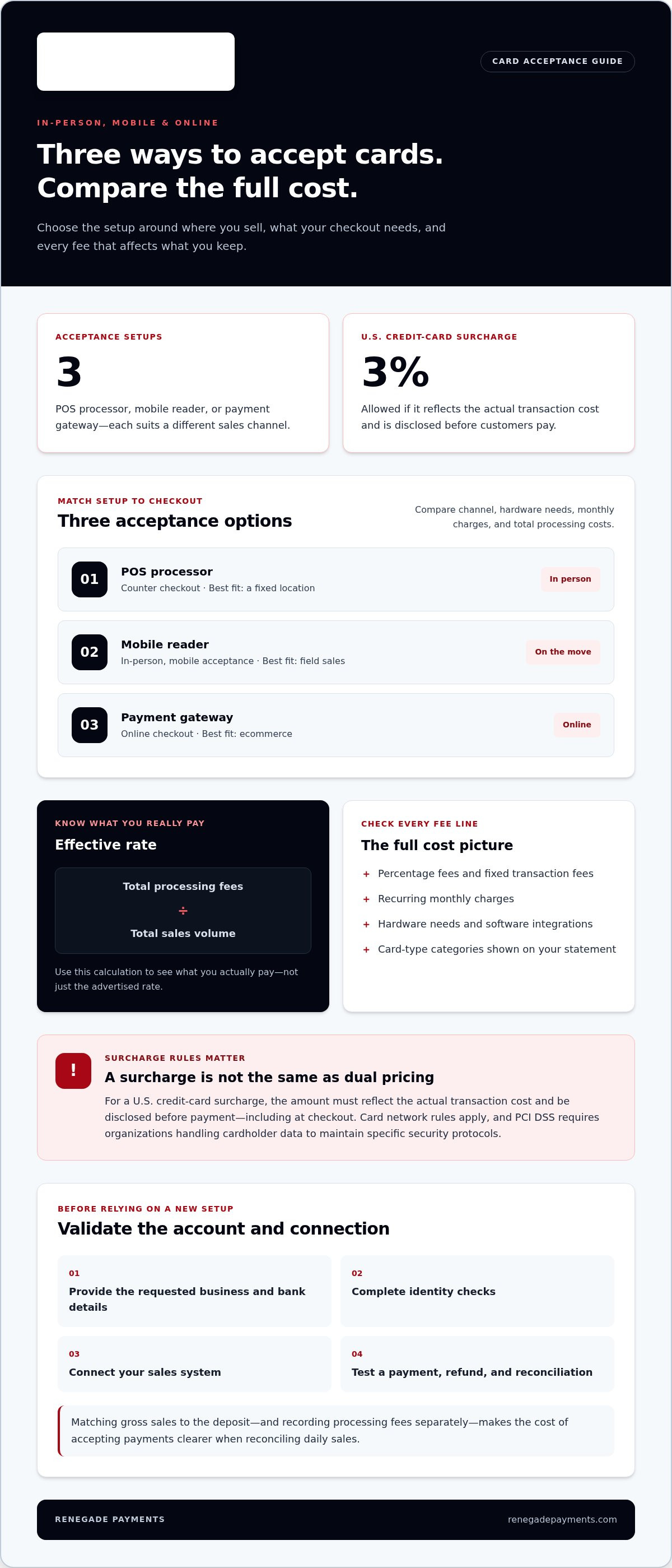
A point-of-sale (POS) system combines checkout tools with card acceptance at a counter or service location. A countertop terminal suits a fixed checkout, while a mobile reader lets you accept credit cards away from the counter. Compare total processing costs, hardware needs, and monthly charges before choosing.
Credit and Debit Card Acceptance
POS systems accept credit and debit cards through a terminal, contactless reader, or mobile device. Processing costs can vary by card type, so review the transaction categories on your statement. For accounting, match gross sales to the deposit, then record processing fees separately. This makes the cost of accepting credit and debit payments clearer when reconciling daily sales.
Surcharges and Required Disclosures
A 3% credit-card surcharge in the United States is allowed if it reflects the actual transaction cost and is disclosed beforehand. Show the surcharge before customers pay, including at checkout. PCI DSS requires organizations handling cardholder data to maintain specific security protocols. Card network rules also shape card acceptance, so don’t treat surcharge rules as interchangeable with dual pricing.
Processor Types and Software Integrations
Integrated processors connect payments with ecommerce platforms, POS systems, or accounting software. A gateway routes online card details, while a POS-connected processor supports in-person sales. To open an account, provide the requested business and bank details, complete identity checks, connect your sales system, then test a payment, refund, and reconciliation. These steps can reveal integration gaps before you rely on the setup.
| Option | Acceptance | Best fit |
|---|---|---|
| POS processor | Counter checkout | Fixed location |
| Mobile reader | In-person, mobile | Field sales |
| Gateway | Online checkout | Ecommerce |
Choose based on your sales channels, full fee structure, and software integrations.
What is payment processing?
Payment processing services move a card transaction from checkout through authorization, clearing, and settlement.
Transaction Fees and Fee Structures
A transaction fee may combine a percentage of each charge with a fixed amount, or use interchange-plus pricing. Card networks set interchange fees, which go to the issuing bank; the processor adds its markup. When comparing payment processors for a small business, examine every fee line, not just the advertised rate. Calculate the effective rate by dividing total processing fees by total sales volume.
Monthly Charges and Pricing Models
Some pricing models include a recurring monthly charge alongside transaction fees; others focus on per-transaction charges. A monthly charge can weigh more heavily on businesses with lower sales volume, while transaction-based costs rise as sales activity increases. Compare recurring charges, percentage fees, fixed fees, and any other listed costs on your statement. For subscriptions, also check how recurring payments and integrations are billed.
Security matters as much as price. PCI DSS requires organizations handling cardholder data to maintain specific security protocols. For online sales, 3D Secure adds a verification step and can reduce fraud risk or shift liability in certain cases. For chargebacks, compare processor tools for dispute alerts, evidence submission, and tracking case status.
As sales grow, compare payment processing services with your changing transaction patterns and costs. Review processing costs regularly, including those for international transactions. Track card volume, average transaction size, and recurring costs separately. This makes it easier to see whether a fee structure still suits your checkout and integrations.
If card costs are squeezing margins, explore Dual Pricing as another way to address processing costs at checkout.
Payment processors for freelancers and international clients
Freelancers often need a way to collect payments remotely, issue invoices, and accept cards on mobile. Online processing pricing typically ranges from 2.5% to 3.5% per transaction or uses interchange-plus pricing, depending on volume and region. Compare the full transaction cost against your typical invoice size and sales pattern, not a promotional headline.
Interchange-plus separates interchange, set by card networks and paid to the issuing bank, from the processor’s markup. This structure shows the components behind each charge. As volume changes, review the markup and other account charges, since pricing can vary with your transaction profile. Check how the pricing model applies to your mix of invoices, card types, and payment channels.
Payment Depot is one example you may encounter while comparing interchange-plus providers. Its specific rates and terms can’t be determined from the pricing model alone. Focus on the written fee structure: interchange, processor markup, recurring charges, and costs tied to the transactions you actually process. This makes comparisons among merchant services and processing companies more useful than brand names alone.
International payments involve more variables. Before choosing a provider, assess support for multiple currencies, foreign transaction fees, exchange rates, security, and payment methods popular in your clients’ markets. For example, an invoice paid in a client’s local currency may involve conversion. Find out which exchange rate applies and where any related fee appears.
Use this practical comparison for each provider:
- Match invoice payments, mobile acceptance, and any recurring billing to your work.
- Review transaction pricing against your sales volume and payment regions.
- Check currency support, exchange-rate handling, and locally popular payment methods.
- Compare statement details after your transaction mix changes.
Choose a setup that fits how clients pay today, then revisit its costs as your volume and international reach grow.
Payment processor transaction flow
A card payment passes through several stages before funds become available. Tracking each stage helps distinguish an authorization from money deposited in your account.
Transaction Processing Stages
At checkout, the platform sends transaction details through the processor to the card network and issuing bank. The issuer approves or declines the payment, then clearing records the transaction between financial institutions. Clearing typically occurs within 24 hours after authorization. Settlement moves the funds onward. A POS platform may show an approved sale immediately, but that screen doesn’t mean the payout has reached your bank.
Deposit Timing and Account Holds
Card payments typically settle to a merchant account in 1-2 business days unless the provider offers expedited payout. Settlement typically takes 1-3 business days, depending on the processor and payment method. A hold can delay access while a provider reviews account details, unusual transaction activity, disputes, or compliance concerns. These reviews differ from the normal processing timeline.
Keep the stages separate in your records. Authorization confirms approval, clearing reconciles transaction records, settlement transfers funds, and the bank deposit makes them available. A sale can appear approved before settlement is complete. Check the transaction status and payout report in your software, then compare the net deposit with sales, refunds, and processing fees. This helps explain timing differences without treating an unsettled payment as missing revenue.
Before launching a new platform, test the full payment path. Run a purchase, issue a refund, review the transaction record, and reconcile the payout. Confirm that receipts and status updates match what customers see. If a deposit is delayed, check its status, review any account notices, and contact customer support with the transaction details. Clear records make the cause easier to identify.
Want a clearer view of processing costs behind each payout? Review your payment processing costs.
Renegade Payments: Dual Pricing
Renegade Payments helps businesses manage card processing costs with Dual Pricing at checkout. Customers see clear pricing options, while merchants can offset credit card processing costs. The right fit depends on your checkout and how you want to present prices to customers.
For a clearer view of current costs, Renegade Payments offers a Free Savings Analysis of your merchant statements to identify processing charges that may be easy to miss. If you prefer itemized pricing, Interchange-Plus separates interchange from the processor’s markup, making the cost structure easier to review.
Compare these approaches against your current statements and checkout needs. Contact Renegade Payments to discuss Dual Pricing, or visit renegadepayments.com.
Make Your Next Processing Decision With Clear Numbers
Your next step is to turn payment activity into a decision you can explain. Use recent merchant statements to map sales channels, card mix, recurring charges, and the costs attached to each transaction. Then decide what matters most: simpler pricing, clearer fee visibility, or a different checkout approach. This gives you a practical basis for comparing payment processing services with the way your business actually accepts payments.
Renegade Payments offers Dual Pricing, Interchange-Plus, and a Free Savings Analysis of current merchant statements. Start by assessing checkout pricing, examining the fee structure, and identifying charges that deserve a closer look. Choose the approach that fits your priorities, not a headline that hides the arithmetic.
Ready to put your numbers to work? Contact Renegade Payments to discuss your processing costs and next steps. Make the decision with clarity, and keep your business moving forward.
Frequently Asked Questions
How do “Wholesale” (Interchange Plus) rates actually save me money?
Interchange-plus separates the card network’s interchange cost from the processor’s markup. That makes the markup visible rather than burying both components in a bundled rate. Savings depend on your card mix, transaction patterns, and the markup applied. Compare statements covering the same period, and include every processing charge. A lower-looking percentage alone doesn’t prove that the total cost is lower.
How long does it take to switch, and will my payments be interrupted?
Switching involves setting up the new account, connecting payment channels, testing transactions, and directing settlements to the correct bank account. Renegade Payments lists average onboarding at 24 hours, but account onboarding and a complete business migration are different steps. Keep your existing setup active while you test a small transaction, refund, and payout in the new system. Move checkout traffic only after those tests work.
Is it illegal to charge 3% credit card fee?
A 3% credit card surcharge isn’t automatically illegal nationwide, but rules depend on card network requirements and state law. Network rules generally cap surcharges at 3% or the actual cost of acceptance, whichever is lower. Never surcharge debit or prepaid cards. Certain states prohibit surcharges entirely, and advance written notice and clear receipt itemization also apply.
What are the top remote payment solutions with customer support tools?
For remote sales, compare payment links, invoicing, hosted checkout, and virtual terminals. A freelancer sending a one-time invoice may need a payment link; a business taking orders by phone may need a virtual terminal. Assess support tools separately: look for transaction search, customer records, refund handling, and dispute-management tools. Choose based on how customers pay and how your team handles payment questions.
What is zero-fee merchant processing?
“Zero-fee” usually describes a setup where the merchant pays no processing fee for eligible in-person card transactions, while card customers pay a service fee. With Dual Pricing, both cash and card prices must appear side by side at the point of sale. The service fee applies only to credit card payments, not debit or prepaid cards. Dual Pricing is for in-person payments, not online, keyed-in, or phone orders.
Which payment provider has the lowest fees?
No provider has the lowest total cost for every business. Compare your effective rate, transaction mix, payment channels, and account charges using actual processing statements. For example, a business with mostly small-ticket sales should account for fixed per-transaction charges, while one with international customers should include currency conversion and foreign transaction costs. The right comparison is the total cost for your own sales pattern.
Frequently Asked Questions
Clear, straightforward answers about payment processing rules, rates, and terms.
Get your free savings
analysis in 24 hours
Upload a recent processing statement and we'll show you exactly how much you can save. No commitment, no pressure, no sales pitch.