Compare merchant processing fees by rate and transaction cost
Learn how to compare merchant processing fees accurately. Evaluate interchange-plus, flat rates, and transaction charges to find your true effective cost.
Published

The lowest advertised rate can cost more once the per-transaction charge and card type enter the math. To compare merchant processing fees fairly, look at the full cost: U.S. credit card processing typically ranges from 1.3% to 3.5% per transaction, often with an additional fixed fee per sale.
That range is only a starting point. Your total depends on how you accept payments, which cards customers use, and how your processor prices its fees. The percentage alone does not show what you actually pay.
Here, you’ll learn what processing fees include, how flat-rate, tiered, and interchange-plus pricing differ, and why online and in-person transactions can cost different amounts. You’ll also learn how to compare providers using the full bill, including per-transaction charges and other fees, so you can assess the actual costs rather than the headline rate.
Key Takeaways
- Separate interchange, network assessments, processor markups, and per-transaction charges to see what makes up the total.
- Flat-rate pricing keeps the calculation simple, while interchange-plus shows the processor’s markup separately from variable interchange costs.
- Online, keyed, and in-person payments can carry different costs, so compare rates using your actual payment mix.
- Calculate your effective rate from total processing fees and card sales, then include recurring and occasional account charges.
- Review monthly statements for fee changes, billing errors, and opportunities to negotiate processor markup.
Table of Contents
What are credit card processing fees?
Each card payment can generate several charges: interchange, network assessments, and the processor’s markup. The pricing model determines how those charges appear on your statement and how easily you can compare them.
Interchange-plus separates the underlying interchange cost from the processor’s markup. Flat-rate pricing bundles costs into a set rate, while tiered pricing groups transactions into categories. Subscription pricing adds a recurring fee for processing access, often alongside transaction costs.
Common Pricing Models
Flat-rate, tiered, interchange-plus, and subscription pricing package processing costs differently. The choice matters because a headline percentage can obscure how card type, transaction method, and monthly volume affect your total.
Tiered pricing sorts transactions into qualified, mid-qualified, and non-qualified categories, each with its own rate. Interchange-plus lists the underlying interchange and a separate processor markup. A subscription model adds a recurring charge, so weigh it against transaction costs rather than treating it as the full price.
Components of Processing Fees
Interchange goes to the cardholder’s bank, assessments go to card networks, and the processor markup pays the processor. These distinct costs explain why two transactions for the same sale amount can generate different fees.
Visa and major card networks set interchange fees, while card networks apply assessments to transactions. Debit interchange is generally lower than credit interchange, and high-rewards credit cards generally carry higher interchange costs for merchants. The processor’s markup is the component that may be negotiated.
The figures show why an interchange-plus quote needs to be read line by line. Major credit card interchange rates averaged around 2.36% in the U.S. recently. Discover’s card-brand assessment fee is 0.130% of transaction value. Neither figure represents the full processing cost, because the processor markup and other applicable charges also matter.
An interchange-plus processor could add a 0.2% markup and 10¢ per transaction. The total combines the card’s interchange, the markup percentage, and the fixed processor charge. A separate EMV chip card example adds 0.3% per transaction to the interchange fee.
Interchange-plus can involve hundreds of interchange rates. The card network, card type, and payment method affect which rate applies. Swiped transactions generally have lower interchange than keyed transactions. An advertised rate cannot show these differences, but an itemized statement can make them visible.
Volume affects the processor markup, not the interchange rates set by networks. Businesses processing over $10,000 monthly may pay lower processing fees by negotiating rates through interchange-plus pricing with Renegade Payments. Compare the markup and per-transaction charge against actual statement activity, rather than judging the offer by a percentage alone.
Flat-rate pricing trades line-by-line detail for a set charge. Tiered pricing simplifies rates by grouping transactions, but the category determines the cost. Subscription pricing adds a recurring cost to transaction charges. Each model calls for a different review: the bundled rate, tier assignment, separate markup, or recurring fee.
Flat-rate pricing
Flat-rate pricing charges one published percentage, often with a fixed transaction fee. For small businesses, the average online processing fee is 2.9% per transaction. A common example is 2.9% plus 30¢, regardless of card type. That consistency makes billing easier to forecast, but it doesn’t mean every payment costs the same amount to process.
The fixed transaction fee weighs more heavily on smaller purchases.
Tiered pricing works differently. The processor assigns transactions to categories such as qualified, mid-qualified, or non-qualified, then applies the corresponding rate. A payment’s category can depend on the card type and how the transaction is accepted. That makes the rate less predictable than a single flat charge. Review transaction counts and category assignments on billing statements, not just the advertised starting rate.
Payment method also affects the comparison. These averages illustrate why a business that accepts cards at a counter and online should compare each channel separately.
Card-present payments generally have lower interchange than keyed transactions. With an in-person chip payment, the card is read at the point of sale. Online checkout and manually keyed payments do not use that same card-present method. A processor’s flat rate may simplify billing across both channels, but the underlying transaction costs can still differ.
Compare provider features alongside pricing. List the percentage, transaction fee, monthly statement fee, minimum processing fee, gateway fee, and chargeback fee. Then review the contract for rate guarantees and termination fees. A low headline rate can become less appealing when recurring or occasional charges are included.
To compare merchant processing fees, use your actual payment mix. Separate in-person, online, and keyed sales, then estimate each channel’s percentage charges and fixed transaction costs. Compare the resulting totals with your monthly bill, including one-time and miscellaneous fees. This gives you a clearer basis for deciding whether a flat rate’s simplicity outweighs differences in transaction costs.
Typical credit card processing rates and per-transaction fees
U.S. credit card processing typically ranges from 1.3% to 3.5% per transaction. The actual rate depends on payment method, card type, processor markup, and fixed charges.
Rates by Card Network and Transaction Type
Average processing costs vary with both the card network and how a transaction is accepted. These figures help frame a comparison, but your card mix affects the actual result.
Network rates can differ too. Visa’s published non-qualified consumer credit interchange rate was 3.15% plus $0.10 per transaction, effective April 18, 2026. That is an interchange rate, not a complete processor quote. Add the processor’s markup and applicable charges before comparing the total.
In-Person, Online, and Keyed Rates
In-person payments generally have lower interchange than keyed transactions. A chip payment is processed differently from a manually entered card number, while an online checkout is also card-not-present. The channel matters because the payment method can change the underlying interchange category and fixed transaction charge.
Compare each channel against its own sales and transaction count. For example, separate monthly totals for in-person, online, and keyed payments. Then include both the percentage and per-transaction fee. A rate that works for larger purchases may take a bigger share of smaller transactions when the fixed charge applies.
Transaction Fees and Other Costs
That charge applies to every transaction, so a high count of low-value purchases can raise the overall cost. Debit cards also generally carry lower interchange than credit cards, while high-rewards credit cards generally carry higher interchange.
Look beyond the transaction line. Startup or annual fees, monthly statement fees, minimum processing fees, gateway fees, and chargeback fees can also affect total account costs. Separate these from the percentage and per-sale charge. Otherwise, a low advertised rate can distract from the full monthly bill.
Volume and Processing Rates
Transaction volume can strengthen a business’s position when negotiating processor markup. Businesses processing over $10,000 monthly may pay lower processing fees by negotiating rates through interchange-plus pricing. The network’s interchange remains distinct from that markup, so focus negotiations on the processor-controlled portion.
Use the effective rate to compare actual costs: divide total processing fees by total card sales, then multiply by 100. Review monthly statements as volume changes, since a different payment mix can alter the total even when the quoted markup stays constant.
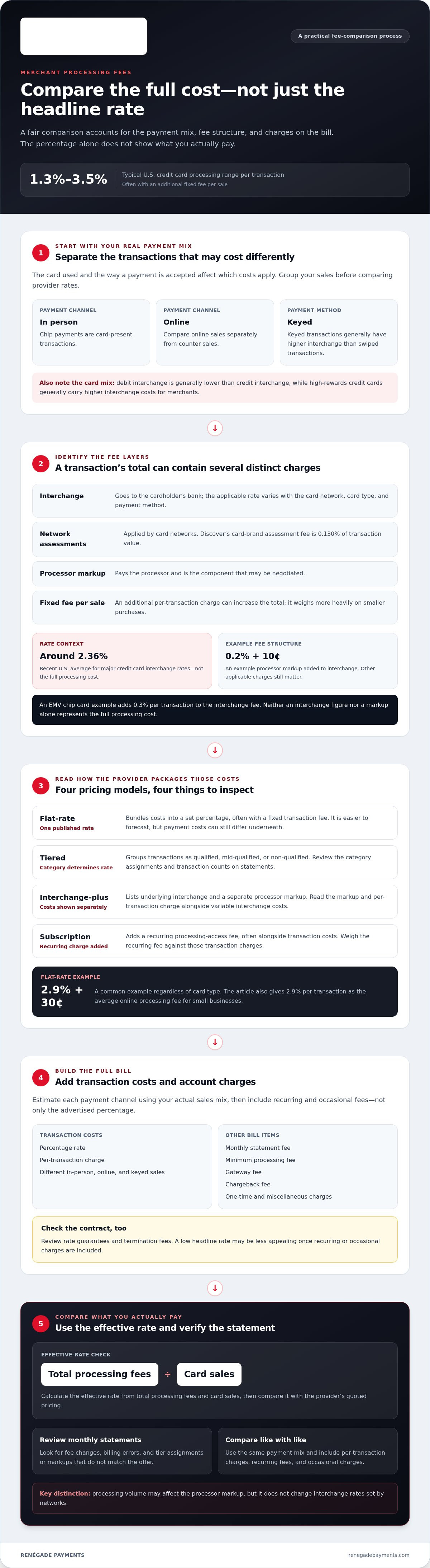
Fees for online and in-person payments
Use monthly statements to identify billing errors, rising charges, and the processor markup. Then compare the markup and optional fees against your transaction mix, and negotiate the processor-controlled portion.
Payment channel changes the cost. Average all-in merchant account costs generally run 2.0%-3.0% for in-person transactions and 2.5%-3.5% for ecommerce payments. Online payments can involve a gateway, while a countertop setup may involve payment equipment. Compare the full charge for each channel, not just one advertised interchange rate.
Separate payment tools from processing charges. A storefront may need a terminal to accept card-present transactions, while an online store may need a payment gateway to route checkout transactions. Hardware, gateway access, and processing are distinct parts of the setup. Identify each line item in the quote, then match it to the tool or service your business uses.
Use the same operating assumptions when comparing payment processor quotes. The provided comparison framework uses $50,000-$500,000 USD per month in processing volume and $50-$200 USD per transaction as its assumptions. If your sales differ, compare quotes using your own monthly volume and average ticket. Otherwise, a percentage or transaction fee may look attractive without matching your actual business.
Review optional charges separately. Startup or annual fees, monthly statement fees, minimum processing fees, gateway fees, and chargeback fees can all affect the account total. A tiered quote may also group transactions into different rate categories. Ask how each category applies to your payment mix, then compare those charges with an interchange-plus quote that lists the processor markup separately.
Selection means weighing more than the rate. Compare one-time and miscellaneous fees, typical monthly costs, rate guarantees, and termination fees. Review how billing reports distinguish online and in-person transactions. For secure data handling, look for PCI Level 1 compliance when assessing providers. Match the equipment, reporting, and payment tools to the channels you use, rather than paying for features your checkout process doesn’t need.
Make the final comparison with a monthly statement and a quote side by side. Match the transaction types, total volume, per-sale charges, and recurring fees. Then calculate the effective rate from total processing fees divided by card sales, multiplied by 100. This gives you a consistent way to compare quotes for in-person and online commerce without letting different pricing formats obscure the total.
Merchant processing provider comparisons
A provider comparison is useful only when every quote uses the same business assumptions. Compare the pricing structure, transaction fees, recurring charges, and contract terms, not just the advertised credit card processing rate. A lower percentage can still mean higher processing costs if fixed charges or monthly fees differ.
Use a consistent baseline. One comparison framework assumes $50,000-$500,000 USD in monthly processing volume and an average transaction of $50-$200 USD. These are comparison assumptions, not a required profile. Replace them with your own sales and ticket size to see how each quote fits your business.
Normalize each quote into the same categories:
- Processing structure: Record whether pricing is flat-rate, tiered, subscription, or interchange-plus.
- Transaction charges: Separate the percentage from any fixed charge per sale.
- Account costs: Include monthly, annual, startup, gateway, minimum, and miscellaneous fees.
- Contract terms: Compare rate guarantees and termination fees alongside expected monthly costs.
Apply each pricing structure to your actual payment mix. A tiered quote groups transactions into categories, while interchange-plus separates the processor markup from interchange. Flat-rate pricing bundles costs into a set amount. Use the same credit, debit, in-person, and online transaction counts for every option. This prevents one provider’s quote from benefiting from assumptions the others don’t share.
Look beyond the rate when reviewing the bill. Compare the quoted total with monthly statements, including one-time and miscellaneous charges. Review statements for fee increases, billing errors, and opportunities to renegotiate. If debit cards make up a large share of sales, account for their generally lower interchange compared with credit cards. Your payment mix can change the effective cost even when the provider’s markup stays the same.
To compare merchant processing fees, calculate each provider’s projected total using the same volume, average ticket, and transaction types. Divide total processing charges by card sales to find the effective rate. Keep the contract term in view: a favorable monthly estimate can be offset by termination fees or charges beyond the headline rate.
Use a statement-based review to expose costs and compare pricing structures. Request a free savings analysis to review current processing charges and identify potential savings.
Renegade Payments: Dual Pricing
Renegade Payments offers Dual Pricing for businesses looking to offset credit card processing fees at checkout. It may suit you if current processing costs are cutting into margins and you want to consider a different pricing approach. Assess how Dual Pricing fits your checkout and how customers see the displayed prices.
For a clearer view of your current costs, Renegade Payments offers a Free Savings Analysis that reviews merchant statements to identify hidden processing charges. Businesses comparing pricing structures can also consider Interchange-Plus, which separates interchange costs from the processor markup. These options help you base the decision on your actual statement and payment mix, not just an advertised rate.
Contact Renegade Payments to discuss your processing fees and pricing options.
Make Your Next Processing Decision With Clear Numbers
Payment pricing deserves regular attention in your operating decisions, not just a quick glance when a new offer appears. Set a clear standard for reviewing changes, and revisit it when your sales channels or payment mix shift. That makes it easier to compare merchant processing fees against your business’s needs, rather than a headline rate designed for a different situation.
Renegade Payments offers a Free Savings Analysis to review merchant statements, alongside Dual Pricing and Interchange-Plus options. Use the analysis to make your next decision with a clearer view of current charges and available pricing approaches. Choose the structure that fits how your business accepts payments.
Contact Renegade Payments to discuss your processing setup and take the next step with confidence.
Frequently Asked Questions
Can you pass transaction fees to the customer?
Merchants can pass card costs to customers through a surcharge only where applicable state laws and card network rules allow it. A 3% credit card surcharge is permitted if it reflects the actual transaction cost and is disclosed beforehand, subject to those rules. Surcharge rules vary by location, so merchants should check applicable requirements before adding one. Rules differ for credit and debit payments, so distinguish the payment type and display any surcharge clearly before checkout.
How much do debit card transactions cost merchants compared to credit cards?
Debit card transactions generally have lower interchange fees than credit card transactions, but the exact charge depends on the card and transaction details. For covered issuers, Regulation II caps debit interchange at $0.21 plus 5 basis points of transaction value, with an additional $0.01 fraud-prevention adjustment available to qualifying issuers. That cap does not apply to every debit card. Issuer size and transaction routing affect which interchange treatment applies.
What Are Merchant Fees?
Merchant fees are the charges a business pays to accept and process electronic payments. They can include card interchange, network assessments, the processor’s markup, and account or transaction charges. For example, a merchant may see a percentage charge on a sale, a fixed amount per transaction, and a separate monthly statement fee. Review each statement line by line so recurring account costs aren’t mistaken for the cost of an individual card payment.
What is the average merchant account fee for small businesses?
There isn’t one average that fits every small business, because in-person and ecommerce payment costs differ. Average all-in merchant account costs generally range from 2.0% to 3.0% for in-person transactions and 2.5% to 3.5% for ecommerce payments. Your total also depends on transaction count, card mix, and account charges. Compare a full statement total with card sales to understand your effective rate, not just the quoted percentage.
What is the cheapest way to accept card payments?
No single pricing model is cheapest for every business. The lowest total depends on your sales channels, average purchase size, transaction volume, and card mix. A business with mostly in-person payments may face a different cost structure from an online seller. Compare quotes using the same sales assumptions, then include fixed transaction charges and account fees. The effective rate on actual card sales is more useful than a starting rate alone.
What is the difference between interchange fees and assessment fees?
Interchange fees are paid to the cardholder’s financial institution for handling a card transaction. Assessment fees are charged by card networks for facilitating transactions. For example, Discover’s card-brand assessment fee is 0.130% of transaction value. These charges serve different roles and aren’t the processor’s markup. When reviewing a statement, identify each separately to see which amounts come from the transaction’s underlying network costs.
What are typical credit card processing fees for merchants in the US?
Typical U.S. credit card processing fees range from 1.3% to 3.5% per transaction. The actual amount varies with card type, transaction method, and pricing structure. An online, keyed, or in-person payment can therefore produce a different total. Compare percentage charges and fixed fees together, then account for any other charges on the statement.
How do interchange, assessment, and processor markup fees differ?
Interchange goes to the cardholder’s bank, assessments go to the card network, and markup goes to the processor. The first two relate to network rules and transaction processing; the markup is the processor’s charge for its service. With interchange-plus pricing, the markup appears separately from interchange. That breakdown helps a business distinguish costs tied to the payment itself from the processor’s pricing.
Frequently Asked Questions
Clear, straightforward answers about payment processing rules, rates, and terms.
Get your free savings
analysis in 24 hours
Upload a recent processing statement and we'll show you exactly how much you can save. No commitment, no pressure, no sales pitch.